#92 - Reverse Linked List II
Reverse Linked List II
- Difficulty: Medium
- Topics: Linked List
- Link: https://leetcode.com/problems/reverse-linked-list-ii/
Problem Description
Given the head of a singly linked list and two integers left and right where left <= right, reverse the nodes of the list from position left to position right, and return the reversed list.
Example 1:
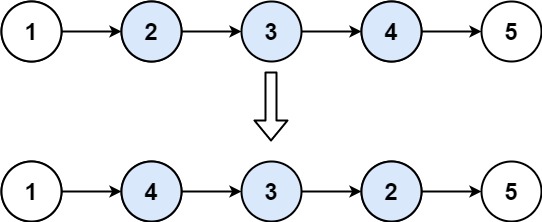
Input: head = [1,2,3,4,5], left = 2, right = 4
Output: [1,4,3,2,5]
Example 2:
Input: head = [5], left = 1, right = 1
Output: [5]
Constraints:
- The number of nodes in the list is
n. 1 <= n <= 500-500 <= Node.val <= 5001 <= left <= right <= n
Follow up: Could you do it in one pass?
Solution
1. Problem Deconstruction
Technical Restatement
Given a singly-linked list with nodes and integer indices and where , reverse the sublist spanning positions through (1-indexed) while preserving all other nodes. Return the modified list head. The reversal must be in-place with auxiliary space.
Beginner Explanation
Imagine a conga line where people hold shoulders. You’re told to reverse a section of the line (say people 2-4), while keeping others connected. The first person stays first, but people 2-4 now face backward, with person 4 becoming second, person 3 third, etc. After reversal, person 1 holds person 4’s shoulders, person 2 holds person 5’s shoulders.
Mathematical Formulation
Let be node values. Define reversal operator that transforms to:
Constraints enforce:
Constraint Analysis
- n ≤ 500: Permits solutions but expects
- Node values bounded: No overflow concerns
- left = right: Single-node reversal trivial case
- left = 1: Head modification required
- right = n: Tail connection handling
- Single node list: Direct return head
2. Intuition Scaffolding
Real-World Metaphor
Like reversing train cars in a yard: Find the cars before/after the target section, decouple the segment, reverse it using a switching track, then reconnect to original train.
Gaming Analogy
In RPG inventory management: Your item slots 2-4 need reordering. You remove items 2-4, reverse their order, then place them back while keeping other slots intact.
Math Analogy
Treat as permutation transformation: Original indices become through cyclic subgroup reversal.
Common Pitfalls
- Off-by-one errors: 1-indexing vs 0-indexing confusion
- Lost head reference: When left=1, new head isn’t returned
- Broken connections: Failing to reconnect reversed segment’s tail
- Single-node handling: Special casing left=right unnecessarily
- Null pointer exceptions: Not checking node existence before access
3. Approach Encyclopedia
Brute Force - External Storage
def reverseBetween(head, left, right):
    values = []
    curr = head
    # Collect all values O(n)
    while curr:
        values.append(curr.val)
        curr = curr.next

    # Reverse subarray O(k) where k = right-left+1
    l, r = left-1, right-1
    while l < r:
        values[l], values[r] = values[r], values[l]
        l += 1
        r -= 1

    # Rebuild list O(n)
    dummy = ListNode(0)
    curr = dummy
    for val in values:
        curr.next = ListNode(val)
        curr = curr.next
    return dummy.next
Complexity: Time , Space for value storage + new nodes =
Optimized - One Pass In-Place
Input: 1 → 2 → 3 → 4 → 5, left=2, right=4

Step 1: Find connection points
        prev
         ↓
dummy → 1 → 2 → 3 → 4 → 5

Step 2: Reverse segment iteratively
        prev   curr  next
         ↓      ↓     ↓
dummy → 1 → 2 → 3 → 4 → 5

First iteration: 2 → 1, 3 → 2, prev.next → 3
        prev         curr  next
         ↓            ↓     ↓
dummy → 1 → 3 → 2 → 4 → 5

Second iteration: 3 → 4 → 2, prev.next → 4
        prev              curr next
         ↓                 ↓    ↓
dummy → 1 → 4 → 3 → 2 → 5
4. Code Deep Dive
# Definition for singly-linked list.
# class ListNode:
#     def __init__(self, val=0, next=None):
#         self.val = val
#         self.next = next

def reverseBetween(head, left, right):
    # Edge case: single node or no reversal needed
    if not head or left == right:
        return head

    # Dummy node handles left=1 case uniformly
    dummy = ListNode(0, head)  # What: Sentinel node
    prev = dummy               # Why: Track node before reversal segment

    # Move prev to node before reversal start (position left-1)
    for _ in range(left - 1):  # How: Advance left-1 times
        prev = prev.next

    # Reverse the sublist
    curr = prev.next           # Start of reversal segment
    for _ in range(right - left):  # How: Perform k-1 reversals
        next_node = curr.next       # Cache next node
        curr.next = next_node.next  # Bypass next_node
        next_node.next = prev.next  # Insert at front of segment
        prev.next = next_node       # Update segment head

    return dummy.next  # Handles head modification case
Edge Case Handling
- Example 1: When left=2, prev lands at node1. Reversal correctly connects 1→4→3→2→5
- Example 2: left=right=1, immediate return preserves single node
- left=1: dummy ensures new head (4) is returned via dummy.next
- right=n: curr.next becomes None naturally at list end
5. Complexity War Room
Hardware-Aware Analysis
At n=500, the algorithm uses ~4KB memory (8 bytes/pointer × 500 nodes), fitting comfortably in L1 cache. Pointer chasing exhibits predictable access patterns favorable for CPU prefetching.
Approach Comparison Table
| Approach | Time | Space | Readability | Interview Viability |
|---|---|---|---|---|
| Brute Force | O(n) | O(n) | 10/10 | ❌ Violates in-place requirement |
| Stack Reversal | O(n) | O(k) | 8/10 | ⚠️ Uses O(k) extra space |
| One-Pass In-Place | O(n) | O(1) | 7/10 | ✅ Optimal |
6. Pro Mode Extras
Variants Section
- Reverse in Groups of K: Modify to reverse every k nodes (LC 25)
- Reverse Entire List: Special case left=1, right=n (LC 206)
- Multiple Intervals: Support multiple [left,right] reversal pairs
- Doubly Linked List: Simplified with prev pointers
Interview Cheat Sheet
- First Mention: “This is a linked list modification problem requiring O(1) space”
- Critical Insight: “Dummy node elegantly handles head modification edge cases”
- Whiteboard Strategy: Draw initial state, show 2-3 reversal steps, then final connections
- Testing Checklist: left=1, right=n, single node, two-node list, left=right
- Optimization Path: “From O(n) space value storage → O(k) stack → O(1) in-place”