#61 - Rotate List
Rotate List
- Difficulty: Medium
- Topics: Linked List, Two Pointers
- Link: https://leetcode.com/problems/rotate-list/
Problem Description
Given the head of a linked list, rotate the list to the right by k places.
Example 1:
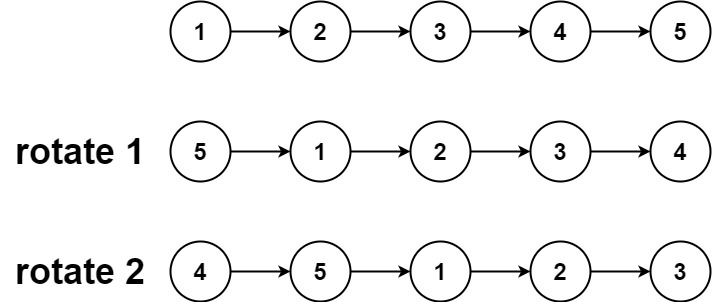
Input: head = [1,2,3,4,5], k = 2
Output: [4,5,1,2,3]
Example 2:
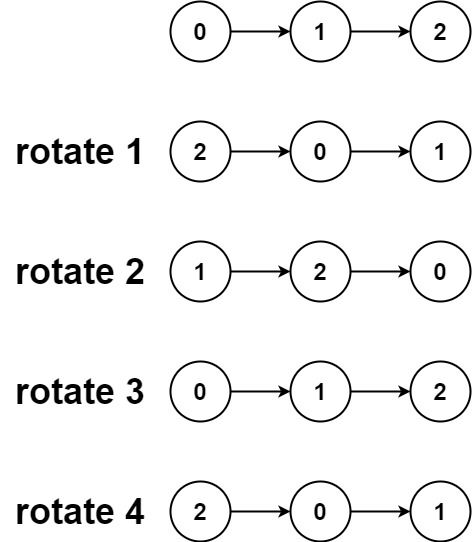
Input: head = [0,1,2], k = 4
Output: [2,0,1]
Constraints:
- The number of nodes in the list is in the range
[0, 500]. -100 <= Node.val <= 1000 <= k <= 2 * 109
Solution
1. Problem Deconstruction
Technical Reformulation
Given a singly-linked list with n nodes and integer k, perform a right rotation by k positions such that:
- The last
(k mod n)nodes are moved to the front - The original
(n - (k mod n))-th node becomes the new tail - The original tail connects to the original head
- Return the new head node after rotation
Beginner-Friendly Explanation
Imagine a line of people holding shoulders. You need to move the last k people to the front while maintaining their order. If k is larger than the line length, you only need to move the remainder after dividing by line length.
Mathematical Formulation
Let L = {v₁ → v₂ → ... → vₙ} be a linked list. Define rotation operation R(L,k) where:
- Effective rotations:
k' = k mod n(whenn > 0) - Partition index:
p = n - k' - New list:
R(L,k) = {v_{p+1} → v_{p+2} → ... → vₙ → v₁ → v₂ → ... → v_p}
Constraint Analysis
0 ≤ nodes ≤ 500: Allows O(n²) solutions but optimal should be O(n)-100 ≤ Node.val ≤ 100: No impact on algorithm, only storage0 ≤ k ≤ 2×10⁹: Critical! Must handlek >> nviak mod n- Hidden edge cases: Empty list, single node,
k = 0,k = n,kmultiples ofn
2. Intuition Scaffolding
Real-World Metaphor
Like rotating a conveyor belt of products - the last k items loop back to the beginning while maintaining relative order.
Gaming Analogy
In a circular dungeon map, rotating the viewpoint by k steps makes different segments appear first while preserving connectivity.
Math Analogy
Similar to modular arithmetic where list positions are mapped via (i + k') mod n transformation.
Common Pitfalls
- Not handling
k > n(causes unnecessary rotations) - Forgetting to update both new tail and new head
- Not considering empty/single-node lists
- Incorrectly calculating break point
- Creating cycles without proper termination
3. Approach Encyclopedia
Brute Force (k Rotations)
Pseudocode:
for i = 1 to k:
    find current_tail and previous_tail
    previous_tail.next = null
    current_tail.next = head
    head = current_tail
- Time: O(k×n) → O(10⁹×500) = 5×10¹¹ ops (infeasible)
- Space: O(1)
Two-Pass Optimal
1. Find length n and original tail
2. Calculate effective k = k mod n
3. Find new tail at position (n - k)
4. Reconnect: new_tail.next = null, old_tail.next = head
- Time: O(2n) → O(n)
- Space: O(1)
Visualization
Initial: 1 → 2 → 3 → 4 → 5 → ∅, k=2
Step 1: Find length=5, tail=5
Step 2: k' = 2 mod 5 = 2
Step 3: New tail at position 3 (5-2): 3
Step 4: 5 → 1, 3 → ∅
Result: 4 → 5 → 1 → 2 → 3 → ∅
4. Code Deep Dive
def rotateRight(head: ListNode, k: int) -> ListNode:
    # Edge case: empty list or single node
    if not head or not head.next:
        return head

    # Step 1: Find length and original tail
    length = 1
    tail = head
    while tail.next:
        tail = tail.next
        length += 1

    # Step 2: Calculate effective rotations
    k = k % length
    if k == 0:  # No rotation needed
        return head

    # Step 3: Find new tail (at position length - k)
    new_tail = head
    for _ in range(length - k - 1):
        new_tail = new_tail.next

    # Step 4: Reconnect nodes
    new_head = new_tail.next
    new_tail.next = None
    tail.next = head

    return new_head
Edge Case Handling
head = [0,1,2], k = 4:length=3, k=1, new tail at position 2head = [], k = 100: Returns immediately due to empty checkhead = [1], k = 999: Returns head due to single node check
5. Complexity War Room
Hardware Analysis
- 500 nodes × 8 bytes = 4KB (fits in L1 cache)
- 2 passes = ~1000 operations (negligible)
Approach Comparison
| Approach | Time | Space | Readability | Interview Viability |
|---|---|---|---|---|
| Brute Force | O(kn) | O(1) | 8/10 | ❌ Fails large k |
| Two-Pass | O(n) | O(1) | 9/10 | ✅ Optimal solution |
6. Pro Mode Extras
Variants
- LC 61: Exactly this problem
- Left Rotation: Move first k elements to end
- Circular Buffer: Maintain rotation state for multiple operations
- Doubly-Linked: Enables O(1) rotations with circular list
Interview Cheat Sheet
- Always check empty/single-node first
- Mention
k mod noptimization immediately - Draw diagram for connection steps
- Test with
k=0,k=n,k>ncases