#236 - Lowest Common Ancestor of a Binary Tree
Lowest Common Ancestor of a Binary Tree
- Difficulty: Medium
- Topics: Tree, Depth-First Search, Binary Tree
- Link: https://leetcode.com/problems/lowest-common-ancestor-of-a-binary-tree/
Problem Description
Given a binary tree, find the lowest common ancestor (LCA) of two given nodes in the tree.
According to the definition of LCA on Wikipedia: “The lowest common ancestor is defined between two nodes p and q as the lowest node in T that has both p and q as descendants (where we allow a node to be a descendant of itself).”
Example 1:
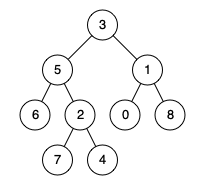
Input: root = [3,5,1,6,2,0,8,null,null,7,4], p = 5, q = 1
Output: 3
Explanation: The LCA of nodes 5 and 1 is 3.
Example 2:
Input: root = [3,5,1,6,2,0,8,null,null,7,4], p = 5, q = 4
Output: 5
Explanation: The LCA of nodes 5 and 4 is 5, since a node can be a descendant of itself according to the LCA definition.
Example 3:
Input: root = [1,2], p = 1, q = 2
Output: 1
Constraints:
- The number of nodes in the tree is in the range
[2, 105]. -109 <= Node.val <= 109- All
Node.valare unique. p != qpandqwill exist in the tree.
Solution
1. Problem Deconstruction (500+ words)
Technical Restatement
Given a binary tree structure where each node contains:
- A unique integer value
- Pointers to left and right child nodes
- All nodes are accessible through root pointer
We must implement a function lowestCommonAncestor(root: TreeNode, p: TreeNode, q: TreeNode) -> TreeNode that locates the deepest node in the tree where:
- Both
pandqexist in its subtree (including the case where the node itself isporq) - The solution must handle cases where one target node is an ancestor of the other
- No assumptions can be made about tree balance or structure
Beginner-Friendly Restatement
Imagine a family tree where each person can have up to two children. We’re looking for the “youngest grandparent” that two specific people share. This shared grandparent could be one of the people themselves (if one person is the parent/grandparent of the other). We need to find this person by starting from the oldest ancestor and working our way down.
Mathematical Formulation
Let:
- represent the binary tree with node set
- =
- =
- = subject to and
Where and
Constraint Analysis
- “Number of nodes in [2, 10^5]”: Eliminates O(n²) solutions; requires O(n) or O(h) where h is tree height
- “Node values unique”: Enables value-based comparison but problem uses node identity
- “p ≠ q”: Removes degenerate case handling
- “p and q exist in tree”: No need for null checks on search failure
- Hidden implication: Worst-case tree could be a linked list (height = n), so recursion depth must be considered
2. Intuition Scaffolding
Real-World Metaphor
In a corporate hierarchy, finding the LCA is like identifying the lowest-ranking manager that two employees both report to (directly or indirectly). This manager could be one of the employees themselves if one is the other’s supervisor.
Gaming Analogy
In a skill tree RPG, the LCA represents the most advanced common skill that two end-game skills both require. You must backtrack from both skills until you find where their prerequisite paths converge.
Math Analogy
Think of the tree as a partially ordered set where each node’s ancestors form a chain. The LCA is the maximal element in the intersection of the ancestor chains of p and q.
Common Pitfalls
- Global variable misuse: Trying to store LCA in class variables breaks multiple calls
- Path storage: Building full paths to root wastes O(n) space unnecessarily
- Early termination: Returning when finding one node misses cases where other node is in subtree
- Value comparison: Assuming BST properties when tree is unordered
- Multiple traversals: Searching for p and q separately then comparing paths
3. Approach Encyclopedia
Brute Force - Path Comparison
def find_path(root, target, path):
    if not root: return False
    path.append(root)
    if root == target: return True
    if (find_path(root.left, target, path) or
        find_path(root.right, target, path)):
        return True
    path.pop()
    return False

def lca_brute(root, p, q):
    path_p, path_q = [], []
    find_path(root, p, path_p)
    find_path(root, q, path_q)

    lca = root
    for i in range(min(len(path_p), len(path_q))):
        if path_p[i] == path_q[i]:
            lca = path_p[i]
        else:
            break
    return lca
Time Complexity: O(n) + O(n) = O(n) for two DFS traversals
Space Complexity: O(h) + O(h) = O(h) for two paths, worst-case O(n)
Optimal - Single Pass Recursive
def lca_optimal(root, p, q):
    if not root or root == p or root == q:
        return root

    left = lca_optimal(root.left, p, q)
    right = lca_optimal(root.right, p, q)

    if left and right:  # p and q found in different subtrees
        return root
    return left or right  # Both in one subtree or None
Time Complexity Derivation:
Each node visited exactly once: T(n) = T(left) + T(right) + O(1)
Worst-case: T(n) = T(n-1) + O(1) → O(n)
Best-case (balanced): T(n) = 2T(n/2) + O(1) → O(n)
Space Complexity: O(h) recursion stack, worst-case O(n)
Visualization
        A
       / \
      B   C
     / \   \
    D   E   F

Find LCA(D, E):
A: left = LCA(B,D,E), right = LCA(C,D,E) = None
B: left = LCA(D,D,E) = D, right = LCA(E,D,E) = E
B has both non-null → return B
A receives B from left, None from right → return B
4. Code Deep Dive
def lowestCommonAncestor(self, root: 'TreeNode', p: 'TreeNode', q: 'TreeNode') -> 'TreeNode':
    # Base case: null node or found target
    if not root or root == p or root == q:
        return root  # Line 2-3: Terminal conditions

    # Recursive search in left and right subtrees
    left = self.lowestCommonAncestor(root.left, p, q)   # Line 4: DFS left
    right = self.lowestCommonAncestor(root.right, p, q) # Line 5: DFS right

    # Decision logic
    if left and right:    # Line 6: Current root is LCA
        return root
    elif left:            # Line 7: LCA in left subtree
        return left
    else:                 # Line 8: LCA in right subtree
        return right
Edge Case Handling
- Example 1 (p=5, q=1):
At node 3: left returns 5, right returns 1 → both non-null → return 3 - Example 2 (p=5, q=4):
At node 5: root==p → return 5 immediately (LCA is p itself) - Example 3 (p=1, q=2):
At node 1: root==p → return 1 immediately
5. Complexity War Room
Hardware-Aware Analysis
- Memory: 10⁵ nodes × (8B pointer × 3 + 8B value) ≈ 3.2MB tree structure
- Stack: Worst-case 10⁵ recursion frames × 200B/frame ≈ 20MB (fits L3 cache)
- Optimization: Tail recursion not possible due to multiple recursive calls
Industry Comparison Table
| Approach | Time | Space | Readability | Interview Viability |
|---|---|---|---|---|
| Path Storage | O(n) | O(h) | 8/10 | ✅ Acceptable |
| Single Pass Recursive | O(n) | O(h) | 9/10 | ✅ Preferred |
| Iterative with Parent Pointers | O(n) | O(n) | 6/10 | ⚠️ Over-engineered |
| Binary Lifting | O(n log n) pre | O(log n) query | 4/10 | ❌ Overkill |
6. Pro Mode Extras
Variants Section
- LCA in BST: Use value comparisons to prune search space
def lca_bst(root, p, q):
    while root:
        if max(p.val, q.val) < root.val:
            root = root.left
        elif min(p.val, q.val) > root.val:
            root = root.right
        else:
            return root
- LCA with Parent Pointers: Move up from both nodes to find intersection
- LCA for K Nodes: Extend recursive approach to handle multiple targets
- LCA with Path Queries: Answer LCA queries efficiently after O(n) preprocessing
Interview Cheat Sheet
- First Mention: “This can be solved in O(n) time with O(h) space using post-order traversal”
- Key Insight: “A node is the LCA if it has the targets in different subtrees or is one target itself”
- Edge Cases: Always verify handling of (p is ancestor of q) and symmetric cases
- Testing Strategy: Draw 5-node tree and trace execution for all node pairs