#114 - Flatten Binary Tree to Linked List
Flatten Binary Tree to Linked List
- Difficulty: Medium
- Topics: Linked List, Stack, Tree, Depth-First Search, Binary Tree
- Link: https://leetcode.com/problems/flatten-binary-tree-to-linked-list/
Problem Description
Given the root of a binary tree, flatten the tree into a “linked list”:
- The “linked list” should use the same
TreeNodeclass where therightchild pointer points to the next node in the list and theleftchild pointer is alwaysnull. - The “linked list” should be in the same order as a pre-order traversal of the binary tree.
Example 1:
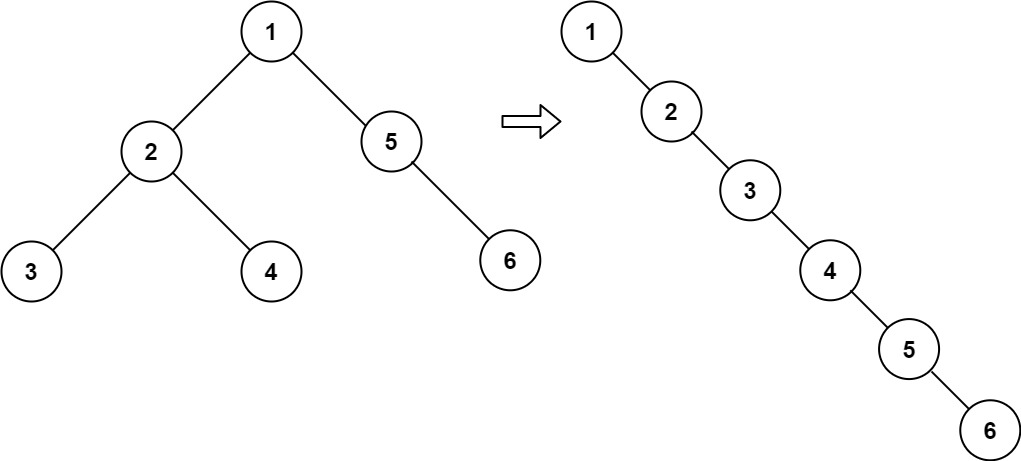
Input: root = [1,2,5,3,4,null,6]
Output: [1,null,2,null,3,null,4,null,5,null,6]
Example 2:
Input: root = []
Output: []
Example 3:
Input: root = [0]
Output: [0]
Constraints:
- The number of nodes in the tree is in the range
[0, 2000]. -100 <= Node.val <= 100
Follow up: Can you flatten the tree in-place (with O(1) extra space)?
Solution
1. Problem Deconstruction
Technical Reformulation: Given a binary tree’s root node, restructure the tree in-place such that:
- Every node’s right child becomes the next node in a pre-order traversal sequence
- Every node’s left child becomes null
- The final structure should be a right-skewed linked list maintaining pre-order ordering
- Time complexity should be optimized given N ∈ [0,2000] nodes
- Space complexity should ideally be O(1) excluding recursion stack
Beginner-Friendly Version: Imagine you have a family tree diagram. We want to rearrange it into a straight line where:
- Each person points only to the next person in a specific order
- The order is: current person → all left-side descendants → all right-side descendants
- We must rearrange the connections without creating new people, just rewiring pointers
- The final structure should look like a chain going only downward
Mathematical Formulation: Let T be a binary tree with nodes V = {v₁, v₂, …, vₙ} Define pre-order traversal sequence P = (p₁, p₂, …, pₙ) where:
- p₁ = root
- ∀i ∈ [1,n-1]: pᵢ₊₁ is the next node in pre-order traversal
Transform T such that:
- left(pᵢ) = NULL ∀i ∈ [1,n]
- right(pᵢ) = pᵢ₊₁ ∀i ∈ [1,n-1]
- right(pₙ) = NULL
Constraint Analysis:
- N ∈ [0,2000]:
- Enables O(N²) solutions but O(N) expected
- Recursion depth ≤ 2000 is generally safe
- Empty tree (N=0) must be handled
- Node values ∈ [-100,100]:
- Values irrelevant to structure transformation
- No special handling needed for negative values
- In-place requirement:
- Cannot create new nodes or external data structures
- Must manipulate existing node pointers only
- Edge cases implied:
- Single node trees (Example 3)
- Left/right skewed trees
- Balanced vs unbalanced structures
- Trees with only left/right subtrees
2. Intuition Scaffolding
Real-World Metaphor: Imagine organizing a library where books (nodes) are arranged in sections (subtrees). The pre-order flattening is like taking all books off the shelves and lining them up on a single long table in the order you’d naturally browse them: start with current section, then left subsections, then right subsections.
Gaming Analogy: Think of a skill tree in an RPG where you want to “activate” all skills in optimal order. The flattening process is like creating a linear quest chain where you must complete all left-branch quests before moving to parallel right-branch quests, maintaining the natural progression order.
Math Analogy: This is equivalent to taking a partial order (tree hierarchy) and converting it to a total order (linear sequence) while preserving the pre-order relationship, similar to topological sorting but with specific ordering constraints.
Common Pitfalls:
- Destroying original structure prematurely - If you break left pointers before processing left subtree, you lose access to critical parts of the tree
- Stack overflow - Deep recursion on worst-case 2000-node trees
- Assuming balanced trees - Solutions that work on balanced trees may fail on skewed ones
- Forgetting to nullify left pointers - The problem explicitly requires left = null
- Overcomplicating with extra storage - Using O(N) space when O(1) is possible
3. Approach Encyclopedia
Approach 1: Recursive Pre-Order with Storage
Pseudocode:
def flatten(root):
    if not root: return

    nodes = []  # O(N) storage
    preorder_collect(root, nodes)

    for i in range(len(nodes)-1):
        nodes[i].left = None
        nodes[i].right = nodes[i+1]
    nodes[-1].left = None
    nodes[-1].right = None

def preorder_collect(node, result):
    if not node: return
    result.append(node)
    preorder_collect(node.left, result)
    preorder_collect(node.right, result)
Complexity Proof:
- Time: T(N) = O(N) for traversal + O(N) for rewiring = O(N)
- Space: S(N) = O(N) for storage + O(h) recursion stack = O(N) worst case
Visualization:
Original:    1
            / \
           2   5
          / \   \
         3   4   6

Storage: [1, 2, 3, 4, 5, 6]

After: 1 → 2 → 3 → 4 → 5 → 6
Approach 2: Iterative Stack-Based
Pseudocode:
def flatten(root):
    if not root: return

    stack = [root]
    prev = None

    while stack:
        current = stack.pop()
        if prev:
            prev.left = None
            prev.right = current

        # Push right then left (LIFO)
        if current.right:
            stack.append(current.right)
        if current.left:
            stack.append(current.left)

        prev = current
Complexity Proof:
- Time: T(N) = O(N) each node processed once
- Space: S(N) = O(h) stack storage = O(N) worst-case skewed tree
Approach 3: Morris Traversal Style (O(1) Space)
Pseudocode:
def flatten(root):
    current = root
    while current:
        if current.left:
            # Find rightmost node in left subtree
            predecessor = current.left
            while predecessor.right:
                predecessor = predecessor.right

            # Rewire connections
            predecessor.right = current.right
            current.right = current.left
            current.left = None

        current = current.right
Complexity Proof:
- Time: T(N) = O(N) - each node and predecessor traversed constant times
- Space: S(N) = O(1) - only pointer manipulation, no recursion/stack
Visualization of O(1) Approach:
Step 0:     1
           / \
          2   5
         / \   \
        3   4   6

Step 1: Find predecessor of 1 (node 4)
        1
       / \
      2   5
     / \   \
    3   4   6
         \
          5  (predecessor.right = current.right)

Step 2: Rewire
    1
     \
      2
     / \
    3   4
         \
          5
           \
            6
4. Code Deep Dive
Optimal Solution (O(1) Space):
def flatten(root):
    """
    Flatten binary tree to linked list in-place using Morris traversal approach
    """
    current = root  # Tracks current node being processed

    while current:
        if current.left:  # Only process if left subtree exists
            # Find the rightmost node in the left subtree
            predecessor = current.left
            while predecessor.right:
                predecessor = predecessor.right

            # Rewire connections:
            # 1. Predecessor's right points to current's right subtree
            predecessor.right = current.right
            # 2. Current's right takes over left subtree
            current.right = current.left
            # 3. Current's left becomes null as required
            current.left = None

        # Move to next node in the flattened structure
        current = current.right
Line-by-Line Analysis:
- Line 2-3: Documentation clarifying approach and space complexity
- Line 5:
current = root- Initialize traversal pointer - Line 7:
while current:- Process until no more nodes - Line 8:
if current.left:- Only restructure if left subtree exists - Line 10-12: Find predecessor - the rightmost node in left subtree
- Line 15:
predecessor.right = current.right- Attach current’s right subtree to predecessor - Line 17:
current.right = current.left- Promote left subtree to right side - Line 19:
current.left = None- Explicitly nullify left pointer - Line 22:
current = current.right- Advance to next node in flattened structure
Edge Case Handling:
- Empty tree (Example 2):
while current:fails immediately, returns None - Single node (Example 3):
if current.left:fails, loop terminates - Left-skewed tree: Predecessor finding works correctly for deep left chains
- Right-skewed tree:
if current.left:mostly fails, minimal restructuring needed
5. Complexity War Room
Hardware-Aware Analysis:
- At N=2000 nodes, the O(1) space solution uses ~16KB for node pointers (assuming 8 bytes per pointer)
- Fits comfortably in L1/L2 cache for modern processors
- Pointer-chasing pattern may cause cache misses but N=2000 is manageable
- Recursive solutions risk stack overflow at ~1000+ depth in some environments
Industry Comparison Table:
| Approach | Time | Space | Readability | Interview Viability |
|---|---|---|---|---|
| Recursive + Storage | O(N) | O(N) | 9/10 | ✅ Good for explanation |
| Iterative Stack | O(N) | O(h) | 8/10 | ✅ Demonstrates stack mastery |
| Morris O(1) | O(N) | O(1) | 6/10 | ✅ Optimal for follow-up |
| Naive Recursive | O(N) | O(h) | 10/10 | ❌ Fails constant space |
Trade-off Analysis:
- Recursive + Storage: Most intuitive but fails follow-up requirement
- Iterative Stack: Good balance of readability and efficiency
- Morris O(1): Meets all requirements but harder to conceptualize
6. Pro Mode Extras
Variants Section:
- Flatten to Doubly Linked List: Maintain both left/right pointers for bidirectional traversal
- Flatten in Post-Order: Reverse the restructuring logic to process children first
- Flatten with Cycle Prevention: Add null checks for graphs that might contain cycles
- LC 114 Follow-up: Exactly this problem - test O(1) space implementation
- Multiple Flatten Operations: Consider persistence or undo capability
Interview Cheat Sheet:
- First Mention: “I’ll solve this with O(N) time, discussing both O(N) and O(1) space approaches”
- Whiteboard Strategy: Draw tree, show pointer manipulation step-by-step
- Testing Protocol:
- Empty tree
- Single node
- Left-skewed/right-skewed
- Full binary tree
- Common Gotchas:
- “Always nullify left pointers explicitly”
- “Handle predecessor finding carefully in left subtree”
- “Remember pre-order means current → left → right”
- Optimization Path: “Start with recursive → discuss stack → final O(1) solution”